Section IV
Crafting Familiarity
“We shall not cease from exploration, and the end of all our exploring will be to arrive where we started and know the place for the first time.”
— T.S. Eliot
Regions
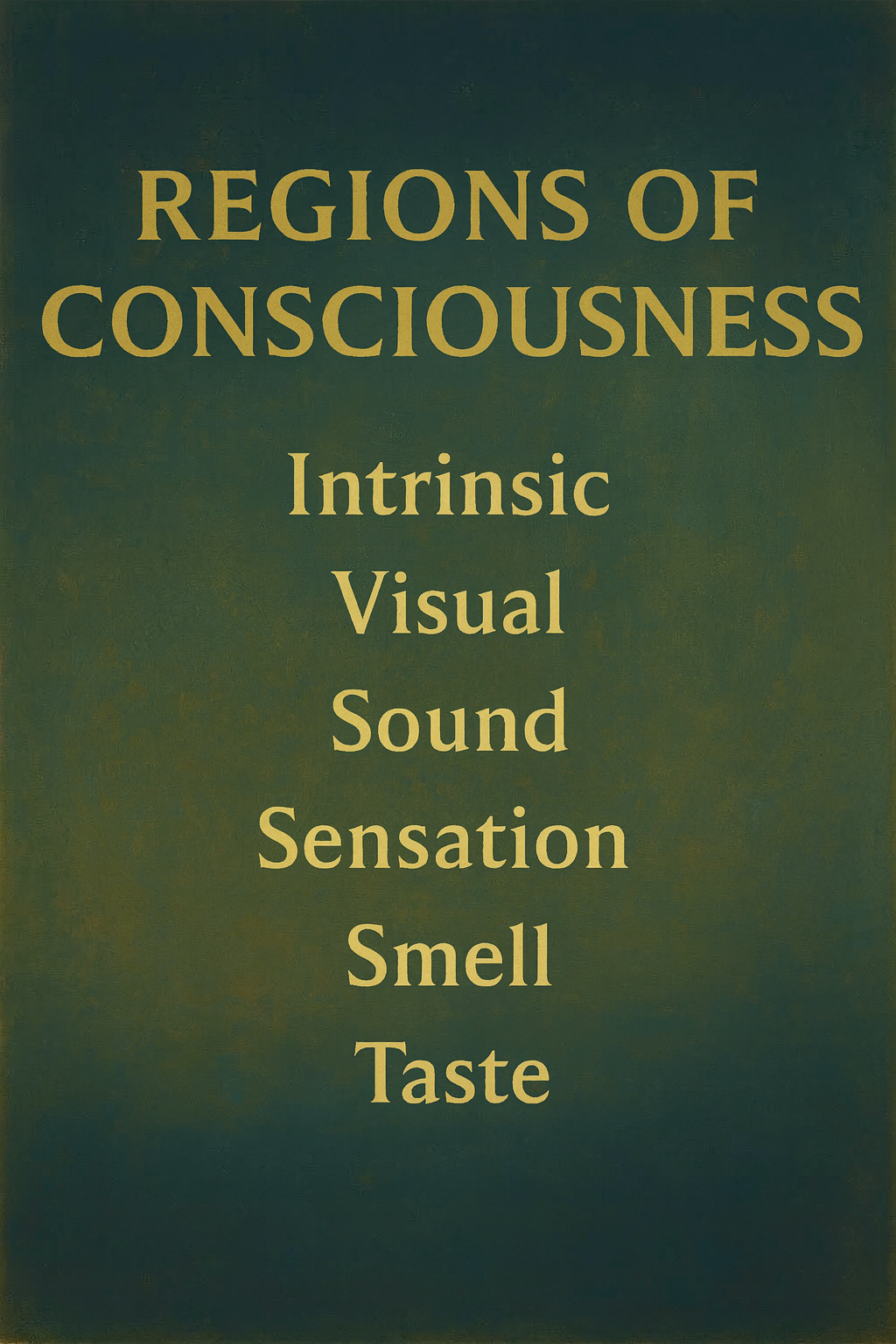
“While I know my consciousness is ultimately unified, breaking it down into regions has helped me become more familiar with its nuances and changes. After all, that’s my primary objective: getting to know and relate to my own consciousness, and living my life according to having one.
To better satisfy that objective, I’ve found it helpful to break consciousness down into six distinct regions—each representing a different aspect of my experience. These regions are: intrinsic, visual, sound, sensation, smell, and taste. Each is anchored, relative to my body, on the opposite side of the coin, and together they form the tapestry of my lived reality.
Employing the coin analogy again helps not only with setting the context of me but also with understanding the flow of time with respect to brain processes and regional activities of consciousness. Time flows from one side of the coin to the other—from the natural version of me in the world to the consciousness version of me in the world. The intrinsic, visual, sound, sensation, smell, and taste processes of me as a brain emerge as the intrinsic, visual, sound, sensation, smell, and taste activities of my consciousness.”
— me – Being What I’ve Always Been
Natural Version
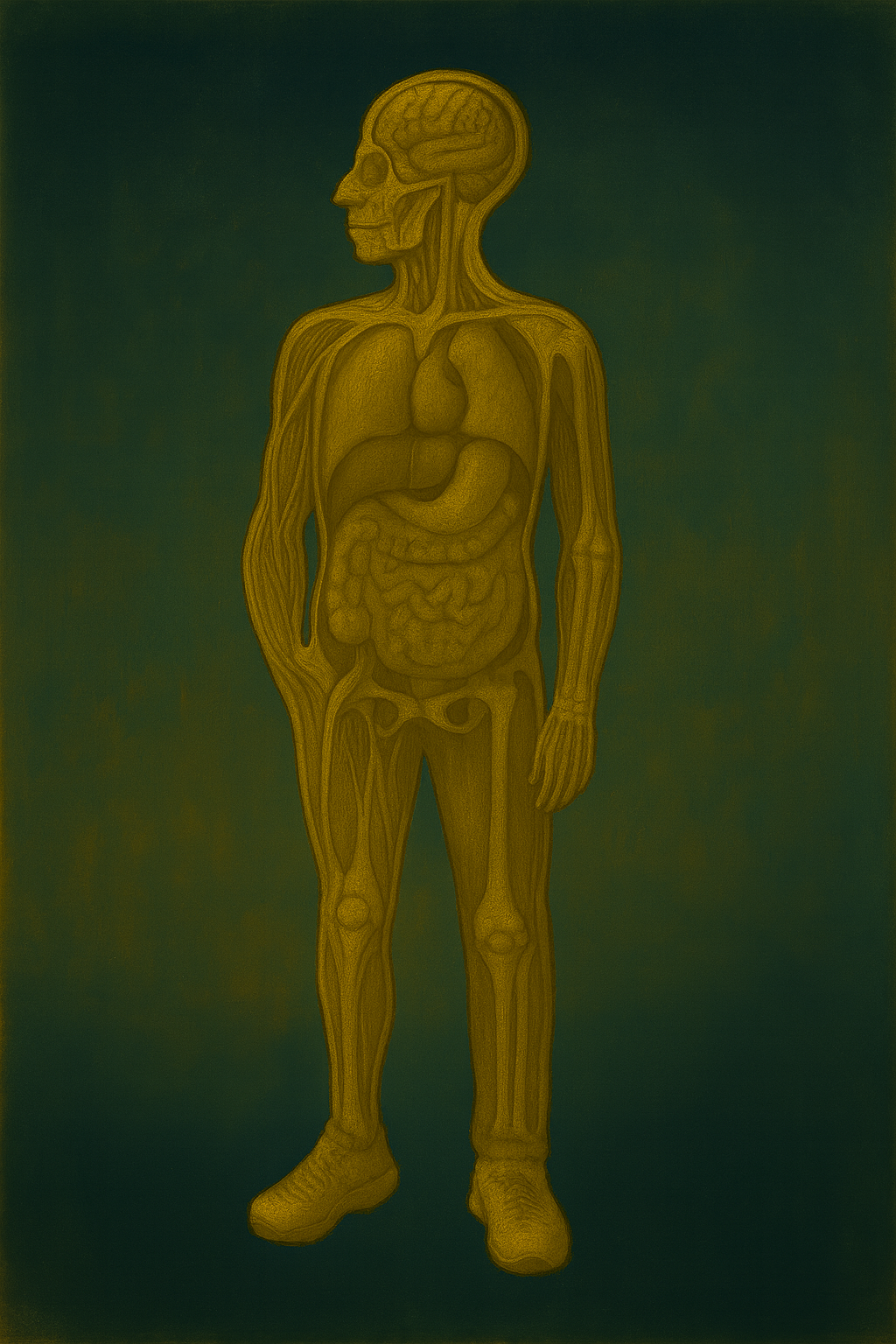
“Funny how a picture can freeze the surface while completely missing the first-person details that made the moment what it really was for me.
Next to that photo is an AI-generated version of what I like to call Tom’s Imaginary Natural Version. It’s my playful way of showing me as a conscious person at the time — along with some of my inners.
And here’s the thing — in the spirit of “In all you do, just be you,” if I had truly tuned in to my consciousness in that moment, even for a couple seconds, I would have noticed an incredible number of qualia details taking place and changing.
But none of those private details show up in either picture.
They’re snapshots of my body in the world — not my inner experience.”
— me – Being What I’ve Always Been
Consciousness Version
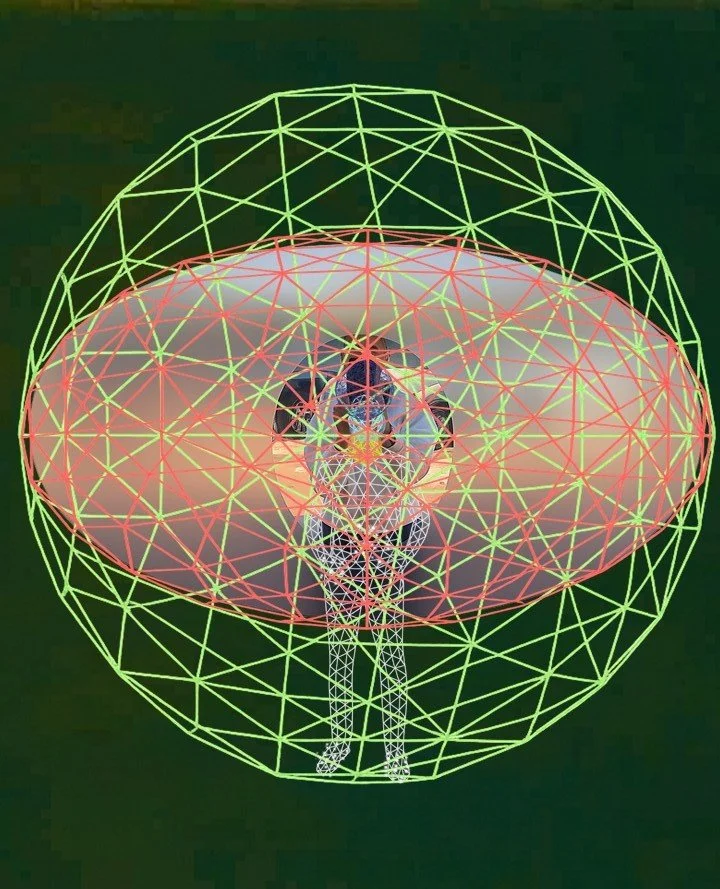
“I call this rendering Tom’s Imaginary Consciousness Version because, let’s be honest, it’s a crude attempt compared to what a real map might look like.
Still, it serves a purpose: helping me explore the contrast between me as a physical person in the world and the neural summary of what it was like to be me in the world.”
— me – Being What I’ve Always Been
Regional Meditation
“All these phases of a Regional Meditation routine are not about forcing change or controlling what arises. It is about becoming familiar with the regions of consciousness as they present themselves, and learning to recognize their shifting patterns while remaining independent of them. The last couple of phases of naming each region and then resting in open awareness have offered me a way to anchor myself in the reality of being a conscious person in the world with my consciousness. Over time, this simple routine is helping me cultivate clarity, steadiness, and a deeper sense of connection to the experience of “me.”
RM blends priming, sensory mapping, body‑location awareness, and symbolic framing (coin, battery, mirror) into a unique practice of conscious orientation. While it shares common ground with several established meditation styles, it diverges in its emphasis on mapping consciousness into distinct regions and anchoring those regions to the felt sense of embodiment.”
— me – Being What I’ve Always Been